A well-targeted ad with sharp copy can still lose money if the page it sends people to gets in the way of what happens next. The click is only half the job. Everything that happens in the few seconds after someone lands, how fast the page loads, how clear the offer is, how obvious the next step feels, decides whether that paid click turns into a result or simply a cost.
The Homepage Is Not a Landing Page
One of the most common and most costly habits in paid advertising is sending every ad to the same general homepage. A homepage is built to serve many different visitors with many different needs, which means it rarely says anything specific enough to match the exact promise made in an ad. Someone who clicked an ad about a particular service arrives expecting to see that service front and centre, and a homepage full of unrelated links and broad messaging creates a small but real moment of doubt about whether they’ve landed in the right place.
A landing page built specifically for a campaign solves this by mirroring the ad almost exactly, same headline theme, same offer, same tone, so the transition from ad to page feels seamless rather than jarring. Search platforms even factor this kind of message match directly into Quality Score, which means a dedicated landing page can genuinely lower cost per click as well as improve conversion rate.
What a Strong PPC Landing Page Actually Includes
A handful of elements consistently separate landing pages that convert well from ones that silently leak paid traffic.
A headline that mirrors the ad’s exact promise, so there’s no gap between what was clicked and what appears.
One single, clear action for the visitor to take, rather than five competing links pulling attention in different directions.
Fast load speed, since paid traffic is often less patient than organic visitors and abandons slow pages quickly.
Enough trust signals, like reviews, credentials, or simple proof of past work, to reassure a visitor who has never encountered the business before.
Simplicity tends to outperform completeness here. A landing page trying to explain everything about a business at once usually explains nothing clearly enough to move someone to act.
Matching the Page to the Ad’s Promise
Message match matters more than most businesses expect. An ad promising “same-day quotes” that lands on a page with no mention of speed anywhere above the fold creates a small disconnect that steadily increases bounce rate, even if the rest of the page is well built. The words, tone, and even imagery used in the ad should feel like they continue naturally onto the page rather than starting a new conversation.
This becomes especially important across multiple campaigns targeting different services or offers. A business running several ad groups for different services genuinely benefits from several corresponding landing pages, each mirroring its own specific ad, rather than funnelling every campaign toward one generalist page that can’t speak precisely to any of them. A local service business advertising across a few nearby suburbs often sees this play out clearly, since a page that names the actual area someone searched from tends to feel more relevant than one written for an entire region at once.
A Short List of Common Landing Page Failures
A few recurring issues show up again and again when a well-targeted campaign underperforms after the click.
The page takes too long to load, particularly on mobile, where paid traffic increasingly arrives from.
The form asks for far more information than is actually needed at this early stage of interest.
The page buries the offer below unrelated content, forcing a visitor to scroll and search for what they clicked to find.
There’s no clear next step, leaving an interested visitor unsure of what to actually do.
Fixing these issues rarely requires an entirely new website. On most modern content management systems, a single focused page can be built and published alongside an existing site without disrupting anything else, which makes a dedicated landing page a fairly low-effort fix for a genuinely expensive problem.
Testing the Page Like Any Other Part of the Campaign
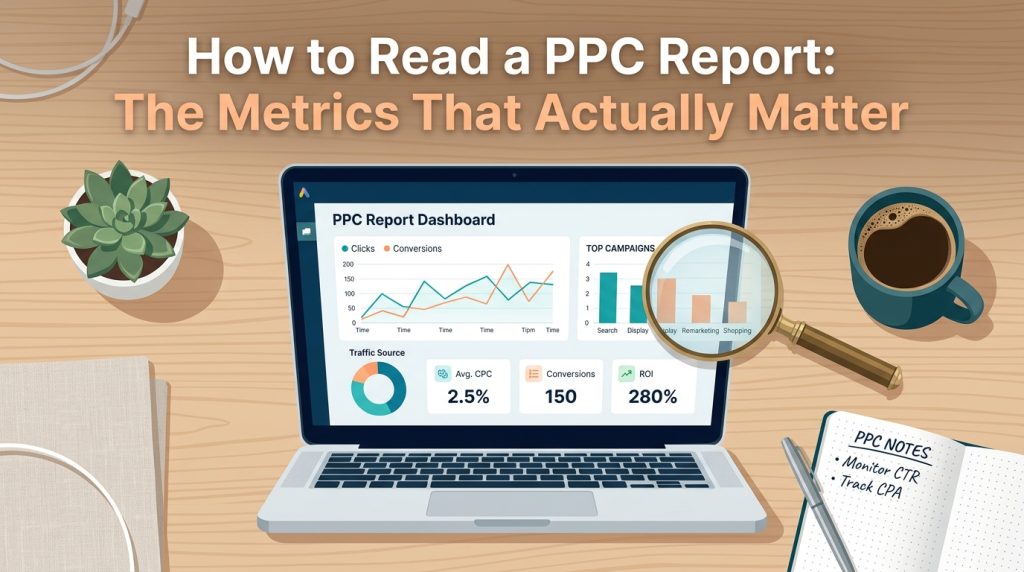
Landing pages benefit from the same testing mindset applied to ad copy and targeting. Small changes, a shorter form, a different headline, a stronger trust signal placed higher on the page, can be tested against each other with real traffic, and the results tend to be surprisingly clear once enough visitors have passed through. A page redesigned around actual behaviour, rather than internal opinion about what looks good, consistently converts better over time, provided the analytics behind it are actually tracking which version visitors saw and what they did next. Once the page is doing its job properly, the final piece is knowing how to read what the resulting campaign report is actually telling you.
Closing the Gap Between Click and Conversion
An ad’s only job is to earn attention and a click. Everything that determines whether that click becomes a genuine result happens on the page that follows, which makes the landing page one of the highest-leverage, most overlooked parts of an entire paid advertising strategy. The complete guide to paid advertising covers how landing pages fit alongside targeting, ad copy, and budgeting as one connected system.
We regularly find that a campaign with mediocre targeting and an excellent landing page outperforms the reverse, which says something about where attention is usually best spent when a budget is tight. Treating the page behind the ad with the same care given to the ad itself is often the single fastest way to improve a campaign that looks fine on paper but isn’t converting the way it should.