Paid advertising rewards businesses that treat it as a discipline rather than a slot machine, and for many small and mid-sized companies it is the first channel that puts a website in front of genuine buyer intent. Search engines and social platforms both compete for the same advertising dollar, and each pulls a business toward a different kind of customer relationship. A good deal of our working week happens inside websites, search consoles and ad managers, and one pattern shows up more than any other: a business launches a campaign, watches the budget disappear within days, and walks away convinced paid advertising simply doesn’t work for them. In almost every case, the platform wasn’t the problem. The structure was. Building a paid strategy that turns spend into revenue is less about finding a secret setting and more about getting a handful of fundamentals right, in the right order, before a single dollar goes out the door.
Why Paid Media Earns Its Own Line in the Budget
Organic search and social content take months to compound. A well-built ad account can put a product in front of a buyer within hours of going live. That speed is exactly why paid media deserves a dedicated strategy rather than a leftover slice of the marketing budget.
There’s a second, less obvious benefit that gets overlooked. Paid campaigns are a live testing ground. Headlines, offers, and images can be tested against real audiences in days, and whatever wins can then feed back into organic content, email subject lines, and even product pages. Businesses that treat their ad account purely as a traffic tap miss this feedback loop entirely. The ones that win treat every campaign as a small experiment with a budget attached, and they let the data change their next move rather than defending the plan they started with.
Paid and organic aren’t competitors for the same dollar. A site with strong technical foundations and clear on-page structure tends to convert paid traffic better too, because the two disciplines are solving overlapping problems: relevance, trust, and speed. A page that already ranks reasonably well organically, for instance, usually loads fast and reads clearly, both of which happen to be exactly what a paid visitor needs as well. Businesses sometimes treat SEO and PPC as separate departments with separate goals, when in practice the healthiest websites are the ones where insight flows freely between the two, and a keyword that performs well in a paid campaign is often worth a second look for organic content too.
The businesses that struggle most with paid advertising tend to share one trait: they judge the entire channel based on a single early campaign that was rushed to launch without much planning. A first campaign built on borrowed assumptions rather than a business’s own data will almost always underperform a second or third attempt built on real results. Paid advertising rewards patience with structure even while it punishes patience with spend, which is a distinction worth sitting with before writing off the channel entirely.
Google Ads or Meta Ads: Choosing Where to Start
The single most common early mistake is picking a platform based on what a competitor is doing rather than what the business actually sells. Search and social ads work on fundamentally different psychology.
Google Ads meets people who are already searching for a solution, which makes it strong for products and services with clear, definable demand.
Meta Ads (Facebook and Instagram) interrupts a scroll, which makes it better suited to visually driven products, impulse purchases, and building awareness before demand exists.
Businesses with a tight budget usually get more reliable early results from whichever platform matches an existing, provable pattern of intent.
A limited test budget split across both platforms at once rarely produces a clean signal either way, since neither gets enough spend to reach statistical confidence.
The decision isn’t permanent. Many businesses eventually run both, but starting with one and learning its mechanics properly beats spreading a small budget thin across two unfamiliar systems. [LINK-CLUSTER-Google Ads vs. Meta Ads: Where Should Your First Ad Dollar Go?: Choosing correctly between the two up front saves a meaningful chunk of wasted early spend.]
The nature of the product or service usually settles the question faster than any amount of debate. A business selling something people already actively search for, a trade, a repair, a specific professional service, tends to see faster, cheaper results on search. A business selling something people don’t yet know they want, or something that benefits from being seen rather than described, tends to find more traction building interest on social first. Neither path is wrong, but picking the one that matches actual buyer behaviour, rather than personal preference for one platform over the other, tends to shorten the distance to a first genuinely profitable result.
What a Well-Built Campaign Structure Actually Looks Like
Underneath every Google Ads or Meta Ads account sits the same basic hierarchy: campaign, then ad group (or ad set), then the ads and keywords or audiences within them. Most underperforming accounts aren’t broken because of the platform. They’re broken because everything was crammed into one giant campaign with no logical grouping.
A campaign should represent a single, clear objective, whether that’s leads for one specific service, sales for one product category, or brand awareness for a launch. Ad groups within that campaign should then split by theme, not by guesswork, so that the keywords or audiences inside each group are tightly related to each other and to the ad copy shown. Loose, mismatched grouping is the hidden reason so many accounts show a high spend and a low return: the platform is doing exactly what it was told, showing broad ads to a broad, unfocused group, and getting broad, unfocused results in return.
Getting this structure right before launch matters more than almost any other setting, because a poorly grouped account is difficult to fix later without starting large portions of it over.
Negative keywords deserve a place in this planning too, not as an afterthought added weeks in. Deciding upfront which searches a business explicitly doesn’t want to pay for, terms that sound related but signal the wrong intent, browsing rather than buying, or a completely different service entirely, keeps early spend from leaking toward traffic that was never going to convert. Reviewing the actual search terms triggering an account in the first week or two of a new campaign tends to surface a handful of these almost immediately, and adding them early is far cheaper than discovering the pattern a month and a sizeable chunk of budget later.
Retargeting: Recovering the Traffic You Already Paid For
Most website visitors leave without converting on their first visit, regardless of how good the ad or the landing page is. That isn’t a failure of the campaign. It’s simply how people shop, especially for anything above a small, low-commitment price point.
A visitor who reached a product page but didn’t purchase is a warmer prospect than someone who has never heard of the brand.
A visitor who added an item to a cart and left is warmer still, and typically responds well to a gentle reminder rather than a hard sell.
Retargeting audiences can be layered by how far someone got, so the messaging shown matches their level of interest rather than treating every past visitor the same way.
Frequency matters here too, since showing the same retargeting ad too often tends to produce fatigue rather than a second look.
This is often the highest-return segment of an entire ad account, simply because the audience has already shown interest once. [LINK-CLUSTER-Retargeting 101: Turning Website Visitors into Paying Customers: Recovering that already-warm traffic is usually the fastest win available once a campaign has been running for a few weeks.]
Retargeting also tends to be one of the more forgiving parts of an account for a modest budget, since the audience is naturally small and the cost per result is usually lower than cold prospecting. Businesses new to paid advertising sometimes hold off on retargeting until later, assuming it needs a large volume of traffic first to be worthwhile. In practice, even a few hundred monthly visitors can support a small, well-targeted retargeting audience, and starting it early means that warm audience is already building from the very first week a campaign runs, rather than being left to accumulate unused.
Budgets, Bidding, and the Real Cost of a Click
Every platform will happily spend whatever daily budget it’s given, so the number entered into that field deserves more thought than it usually gets. A budget set too low starves the algorithm of the data it needs to learn who converts, while a budget set too high without a tested campaign structure just accelerates losses.
Bidding strategy matters almost as much as the budget itself. Manual bidding gives more control but demands more hands-on management, while automated bidding strategies (built around a target cost per action or return on ad spend) can perform well once a campaign has enough conversion history for the algorithm to learn from. Switching bidding strategies too early, before enough data exists, is one of the more common ways businesses accidentally reset their own progress. A campaign generally needs a stretch of consistent performance before any bidding changes are worth testing.
Seasonality is worth planning around rather than reacting to after the fact. A retail business, for example, can usually predict roughly when demand rises heading into major shopping periods, and adjusting budget upward slightly ahead of that curve tends to work better than scrambling to increase it once competitors have already driven costs up. The same logic applies in reverse during predictably slower stretches of the year, where maintaining full budget against thinner demand mostly just inflates cost per result without a matching lift in conversions.
Ad Copy That Earns the Click
The best-targeted campaign in the world underperforms if the ad itself gives someone no reason to click. Good ad copy isn’t about clever wordplay. It’s about speaking directly to the specific problem a searcher or scroller already has in that moment.
Strong performing ads tend to lead with a clear, specific benefit rather than a vague claim, use language that mirrors how a real customer would describe their own problem, and include a next step that feels low-risk rather than pressured. Numbers, specifics, and plain language consistently outperform generic claims about being the best or the most trusted option in a category, mostly because every competitor’s ad says the same thing. [LINK-CLUSTER-The Ad Copy Formula: Writing PPC Ads That Actually Get Clicks: The difference between an ad that gets scrolled past and one that gets clicked usually comes down to a handful of copywriting habits.]
Testing more than one version of an ad at a time, rather than writing a single version and leaving it running indefinitely, tends to reveal patterns that guesswork never would. A phrase that seems obvious in a meeting room doesn’t always resonate the way a genuinely tested alternative does once real searchers or scrollers get to weigh in with their clicks.
Targeting the Right People Without Wasting Spend
Search and social platforms approach targeting from opposite directions, and understanding that difference changes how a campaign should be built from day one. Search targeting starts with intent, built around the exact words someone typed, while social targeting starts with a profile, built around interests, behaviours, and demographics.
Neither approach is inherently better, but each has a failure mode worth watching for. Overly broad keyword targeting on search platforms tends to attract browsers rather than buyers, inflating cost per click for the wrong audience. Overly narrow interest targeting on social platforms can shrink an audience so much that the algorithm never gets enough data to optimise properly. The middle ground, specific enough to be relevant and broad enough to give the algorithm room to learn, is where most well-performing accounts eventually settle.
Location matters more than it’s often given credit for, particularly outside of major metro areas. A business serving a defined region gains little from an audience that technically fits every other criterion but sits well outside a realistic service radius, and narrowing geography deliberately, rather than leaving it at a broad national default, is one of the simplest ways to immediately improve relevance across either platform.
The Landing Page Is Part of the Ad
An ad’s job doesn’t end when someone clicks. Everything after that click, the page load speed, the headline match, the clarity of the offer, decides whether that click turns into a lead or a lost dollar. Search platforms even factor landing page relevance directly into Quality Score, which affects both ad rank and cost per click.
A landing page built specifically for a campaign, with a headline that mirrors the ad’s promise and a single clear action for the visitor to take, will consistently outperform sending paid traffic to a general homepage. Businesses spend a disproportionate amount of time refining ad copy and targeting while sending that hard-won traffic to a page that was never built with a paid visitor’s mindset in mind. [LINK-CLUSTER-Landing Pages for PPC: Why Your Ads Fail After the Click: The page behind the click carries as much weight in a campaign’s success as the ad that led there.]
Mobile behaviour deserves particular attention here, since a growing share of paid clicks, especially from social platforms, arrive on a phone rather than a desktop. A page that looks polished on a large monitor but takes several extra seconds to load or requires awkward pinching and scrolling on a phone will lose a meaningful share of visitors before they ever see the offer clearly. Testing a landing page specifically on mobile, rather than assuming a desktop preview tells the full story, catches problems that would otherwise only show up in a disappointing conversion rate weeks later.
Metrics That Actually Tell You Something
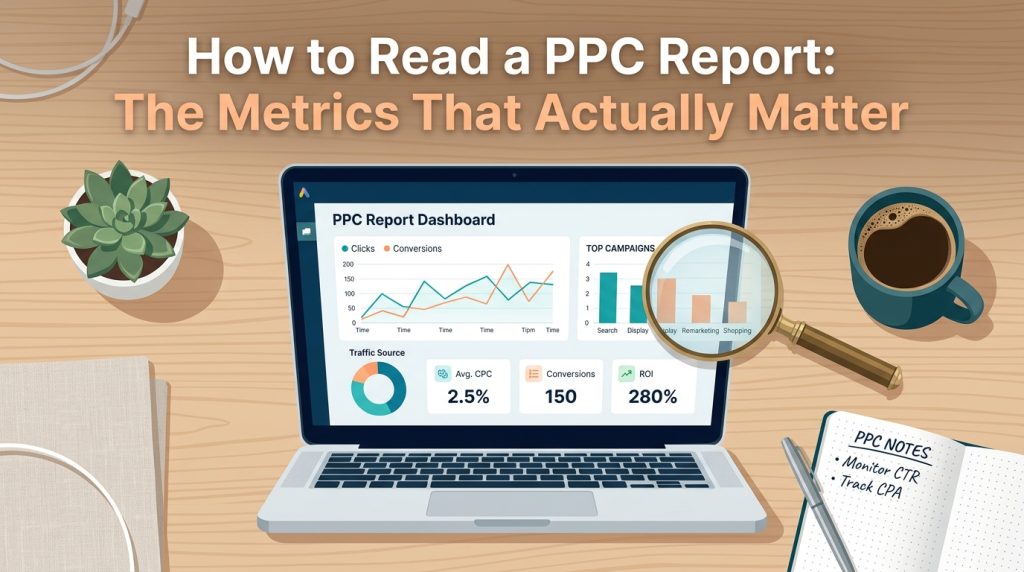
Click-through rate and impressions feel satisfying to watch, but they rarely tell the full story on their own. A campaign can have an excellent click-through rate and still lose money if the traffic it attracts never converts.
Cost per acquisition and return on ad spend sit closer to what actually matters, since both connect spend directly to revenue rather than stopping at engagement. Conversion rate, viewed alongside cost per click, reveals whether a high cost per click is actually a problem or simply the price of a highly qualified audience that converts well once it arrives. Reading these numbers together, rather than chasing any single metric in isolation, is what separates a campaign that gets optimised correctly from one that gets tweaked based on a misleading headline number.
Attribution windows, the length of time after a click or view that a conversion still gets credited to that ad, also shape how a report should be read. A short attribution window can understate a campaign’s real impact for a purchase decision that takes a week or two to settle, while an unusually long window can occasionally overstate it. Understanding which window a platform is using by default, rather than assuming every conversion reported is a same-day decision, prevents a lot of unnecessary second-guessing about numbers that are actually behaving normally.
Turning Ad Spend Into a Growth Engine
Paid advertising rarely fails because a platform is broken. It fails when structure, targeting, copy, and landing pages are treated as separate problems rather than parts of the same system, each one steadily undermining the others when left unchecked. A campaign built with attention to all of them, and reviewed against the metrics that actually connect to revenue, tends to become more efficient over time rather than less, which is the opposite of how most businesses experience their first attempt at paid media.
We work alongside businesses building exactly this kind of foundation, from the website a campaign ultimately sends people to, through to the analytics that show whether that spend is actually paying off. A profitable paid strategy is rarely built in a single afternoon, but it is built, piece by piece, by getting each of these fundamentals right before scaling the budget behind them.